Kids will happily play the same game twenty times, and that's exactly what math facts need: lots of repetition that doesn't feel like work. The trick is picking a game that fits the grade. Too easy and they're bored; too hard and it stops being a game.
This guide lists simple, low-prep educational math games for every grade from kindergarten to 5th. All you need is a deck of cards, two dice, paper and a pencil.
What makes educational math games work?
The best educational math games share three things:
- One skill at a time. A game about adding to 10 should only ask for adding to 10.
- Fast turns. Each turn takes a few seconds, so a child answers dozens of problems in ten minutes.
- A bit of luck. Dice and cards give a younger child a real chance of beating an older sibling or a parent.
For card games below, remove the face cards and count an ace as 1.
Kindergarten math games
Kindergarten math games should build counting, comparing and number recognition up to 20.
- Roll and build. Roll one die and build a tower with that many blocks. Roll again and add to it. The first tower to reach 20 blocks wins.
- More or less. Each player flips a card. Whoever has the bigger number keeps both. Ask "how many more?" for a harder version.
- Number hunt. Call out a number and have your child find that many things in the room: 6 spoons, 9 crayons, 12 socks.
Math games for 1st graders
Math games for 1st graders focus on adding and subtracting within 20 and on the pairs that make 10.
- Make 10. Play Go Fish, but instead of matching cards you collect pairs that add up to 10: 3 and 7, 4 and 6, 1 and 9.
- Dice race. Each player rolls two dice and adds them. The higher total scores a point. First to 10 points wins.
- Count back. Start at 20. Take turns rolling one die and subtracting. The first player to land exactly on zero wins.
Math games for 2nd graders
Math games for 2nd graders move on to two-digit numbers, place value and adding with regrouping.
- Race to 100. Roll two dice and make a two-digit number (a 3 and a 5 can be 35 or 53). Add it to your running total on paper. The player closest to 100 without going over wins.
- Biggest number. Each player flips two cards and arranges them into the biggest two-digit number they can. Bigger number takes the cards.
- Skip-count catch. Toss a ball back and forth, counting by 2s, 5s or 10s. Drop the ball or miss a number and you start again.
If the adding step is shaky, our guide to addition and subtraction with regrouping walks through it.
Multiplication math games (3rd grade and up)
Once times tables start in 3rd grade, multiplication math games are the fastest way to make the facts stick.
- Multiplication war. Each player flips two cards and multiplies them. The bigger product takes all four cards.
- Roll and cover. Write the numbers 1 to 36 on a sheet. Roll two dice, multiply them and cross off the answer. The first player to cross off five numbers wins.
- Times table hopscotch. Chalk the answers to one table (3, 6, 9, 12...) into a hopscotch grid and say each one out loud as you land on it.
More ideas for this age: 3rd grade math practice and games.
Math for 4th graders: games that build fluency
In math for 4th graders, games should stretch into bigger multiplication, division and multi-step thinking.
- Target number. Flip four cards and one "target" card. Use any of the four numbers with +, −, × or ÷ to get as close to the target as you can.
- Remainder race. Flip two cards to make a two-digit number, then roll a die and divide by it. Your remainder is your score for that round. Highest total after five rounds wins.
- Double it. Start at 3 and take turns doubling: 6, 12, 24, 48... See how far you can go without paper.
See also: fun math games and 4th grade math practice.
Math games for 5th graders
Math games for 5th graders can bring in fractions, decimals and order of operations.
- Fraction war. Each player flips two cards and makes a fraction with the smaller number on top. The bigger fraction wins the round. Players have to explain why theirs is bigger.
- Make 24. Flip four cards. Use all four numbers once, with any operations, to make exactly 24.
- Decimal dice. Roll three dice and arrange them as a decimal, like 4.26. The biggest number wins one round, the smallest wins the next.
Turn practice into a game with Math Teacher
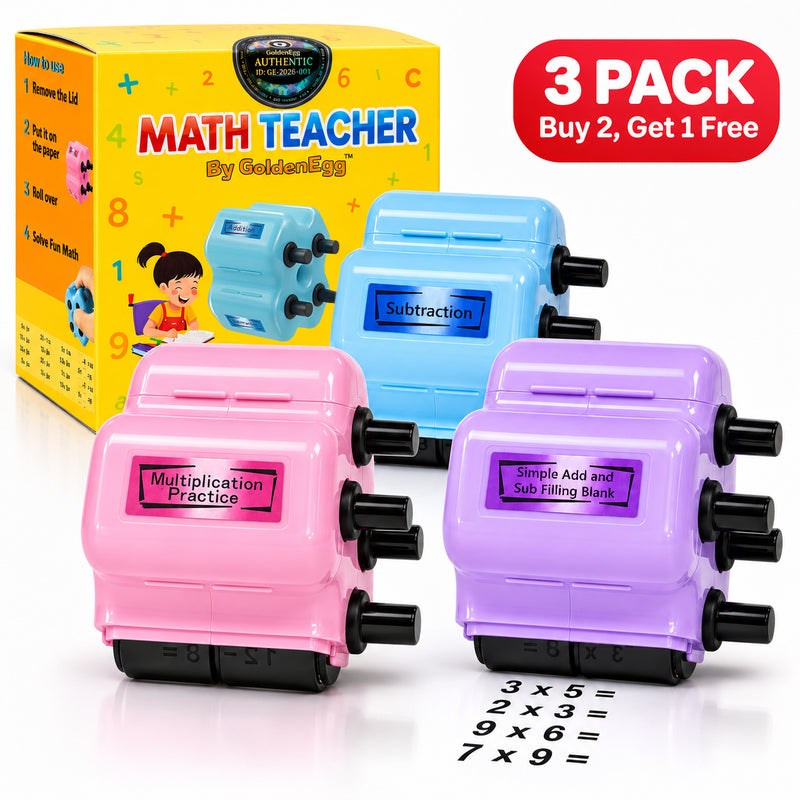
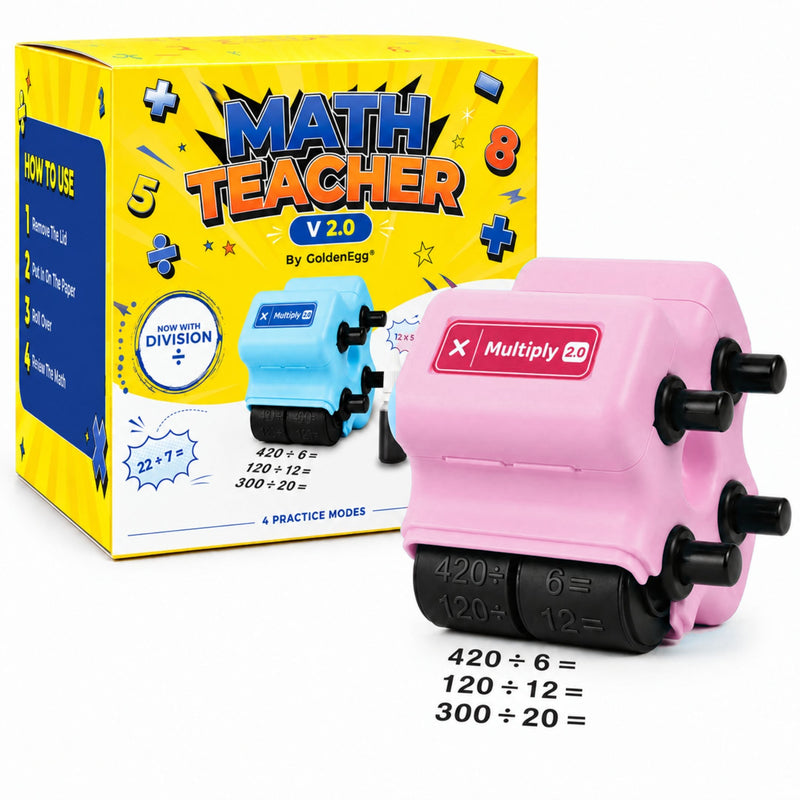
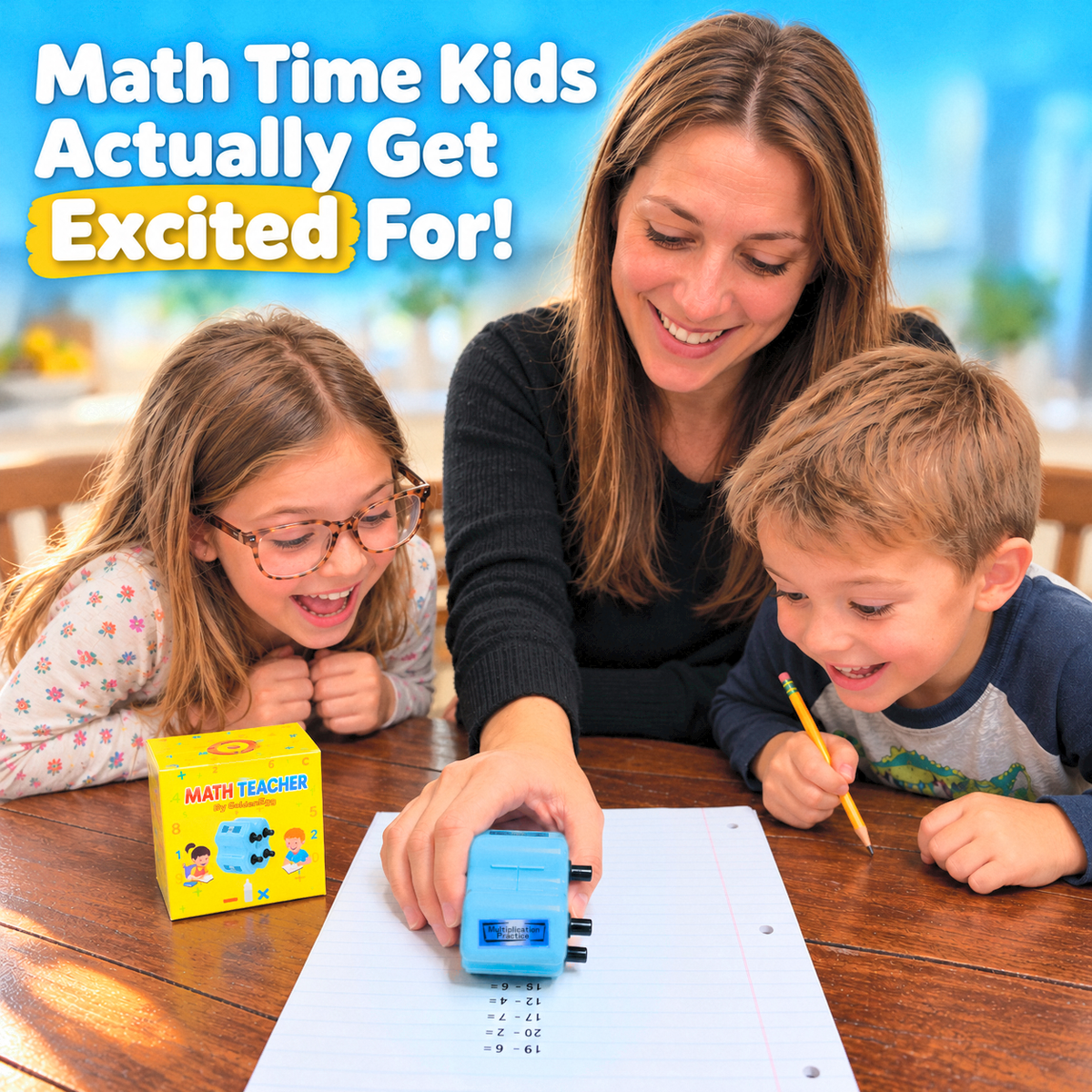
Games work best when fresh problems are always ready. That's what Math Teacher does: roll the stamp down any page and it prints a new column of problems to solve in pencil, with different numbers every time. Kids love the rolling, so practice already feels like play.
Two easy ways to make it a game:
- Beat your time. Roll one column, start a timer and solve. Tomorrow, roll a new column and try to beat yesterday's time.
- Sibling race. Roll a column for each child and see who finishes first with every answer right.
- Math Teacher (Original), ages 3-8: addition, subtraction, multiplication facts and fill-in-the-blank. A good fit for kindergarten to 2nd grade.
- Math Teacher 2.0, ages 7-10: 2-digit addition and subtraction, bigger multiplication and long division. A good fit for 3rd to 5th grade.
Every stamp includes our free Math Help: snap a photo of the stamped page and every answer gets marked, with short video lessons to fix mistakes.
Frequently Asked Questions
Final Thoughts
Pick one game for your child's grade, play it for ten minutes a day this week, and swap in a new one when it gets easy. A deck of cards, two dice and a little friendly competition go a long way.