Regrouping is the moment math stops being about single facts and starts being about place value. It's usually taught in 2nd grade, and it's where many kids first get stuck. The good news: addition and subtraction with regrouping follow the same simple idea, and once a child sees it, both click.
This guide explains regrouping in plain language, then walks through 2 digit addition regrouping, 2 digit subtraction with regrouping and 3-digit addition, with the mistakes to watch for.
What is regrouping?
Regrouping means trading between place values. Ten ones are the same as one ten, and one ten is the same as ten ones.
- In addition, when a column adds up to 10 or more, you trade ten ones for one ten and move it to the next column. This is often called carrying.
- In subtraction, when the top digit is too small, you trade one ten for ten ones. This is often called borrowing.
Showing this with real objects first helps a lot. Bundle ten pencils with a rubber band to make "a ten," and let your child trade bundles and single pencils.
2 digit adding with regrouping, step by step
Here is 2 digit by 2 digit addition with regrouping, using 47 + 38.
- Line up the digits. Write 38 under 47 so the ones are under the ones and the tens are under the tens.
- Add the ones. 7 + 8 = 15. That's 1 ten and 5 ones.
- Write the 5, carry the 1. Put 5 in the ones place and a small 1 above the tens column.
- Add the tens. 4 + 3 + 1 (the carried ten) = 8.
Answer: 47 + 38 = 85.
When your child works through 2 digit addition problems with regrouping, have them say the trade out loud: "15 ones is 1 ten and 5 ones." Saying it keeps the meaning attached to the steps. For a closer look at this one skill, see 2-digit addition with regrouping.
2 digit subtraction with regrouping, step by step
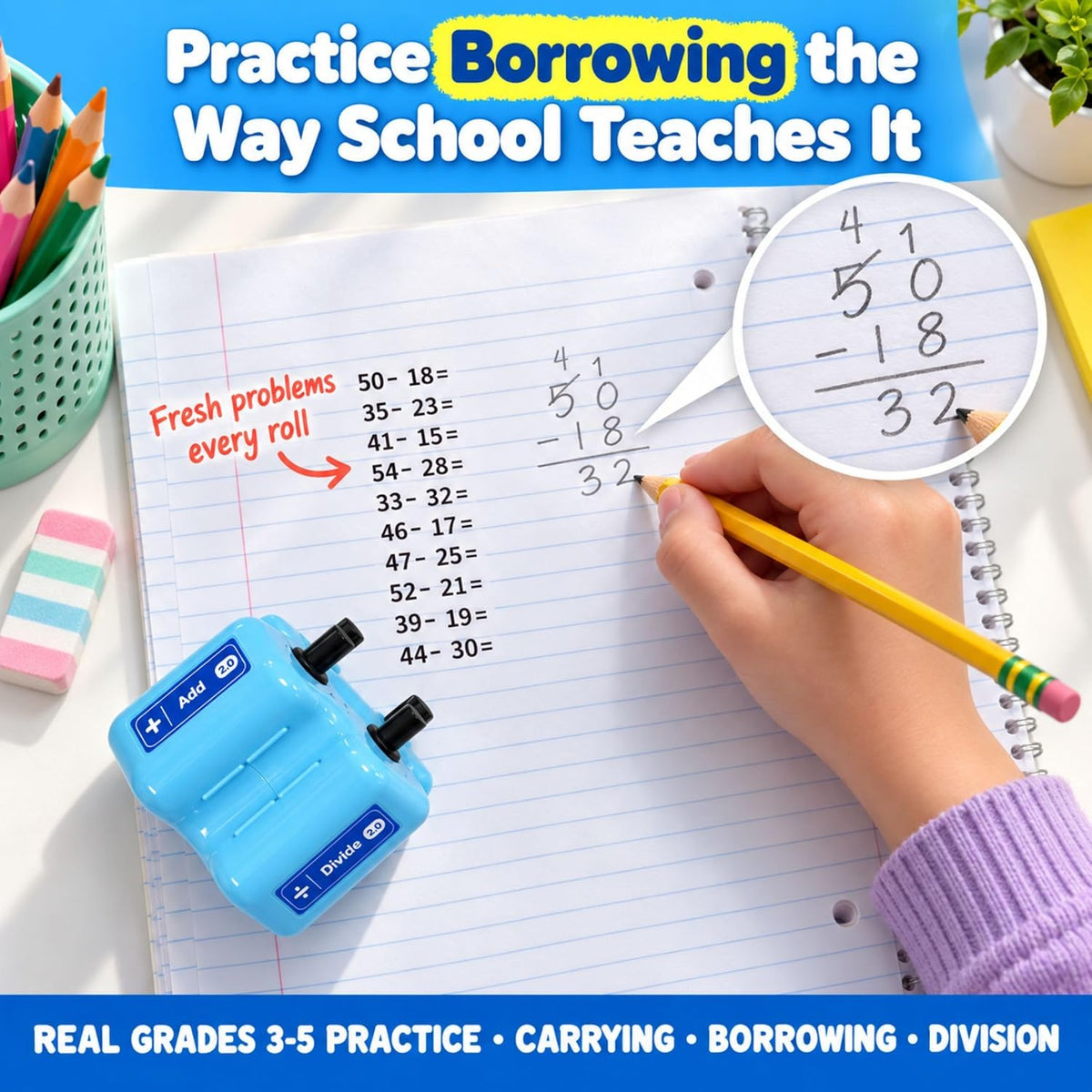
Now 2 digit by 2 digit subtraction with regrouping, using 52 − 27.
- Line up the digits. Write 27 under 52.
- Look at the ones. 2 − 7 can't be done, because 2 is smaller than 7.
- Borrow a ten. Cross out the 5 and write 4. The 2 ones become 12 ones.
- Subtract the ones. 12 − 7 = 5.
- Subtract the tens. 4 − 2 = 2.
Answer: 52 − 27 = 25.
Teach your child to check every subtraction by adding back: 25 + 27 should give 52. More detail on this skill: 2-digit subtraction with regrouping.
Addition: 3 digit regrouping
In 3-digit addition, regrouping can happen twice. The steps are the same; there's just one more column. Take 368 + 475.
- Add the ones. 8 + 5 = 13. Write 3, carry 1 to the tens.
- Add the tens. 6 + 7 + 1 = 14. Write 4, carry 1 to the hundreds.
- Add the hundreds. 3 + 4 + 1 = 8.
Answer: 368 + 475 = 843.
A child who is solid on two-digit regrouping usually picks this up quickly. If three digits is a struggle, go back to two digits for a few more days first.
4 common regrouping mistakes
- Forgetting to add the carried 1. Have your child write it clearly above the next column and circle it.
- Writing both digits. Writing 15 in the ones place turns 47 + 38 into 715. Remind them each place holds one digit.
- Subtracting the smaller from the larger. In 52 − 27, some kids do 7 − 2 instead of borrowing. Ask, "Which number is on top?"
- Forgetting to reduce the tens after borrowing. Crossing out the 5 and writing 4 is the step that gets skipped most.
How to practice regrouping at home
Regrouping becomes automatic through short, regular practice: about 10 minutes a day, a few problems at a time, with the steps said out loud at first.
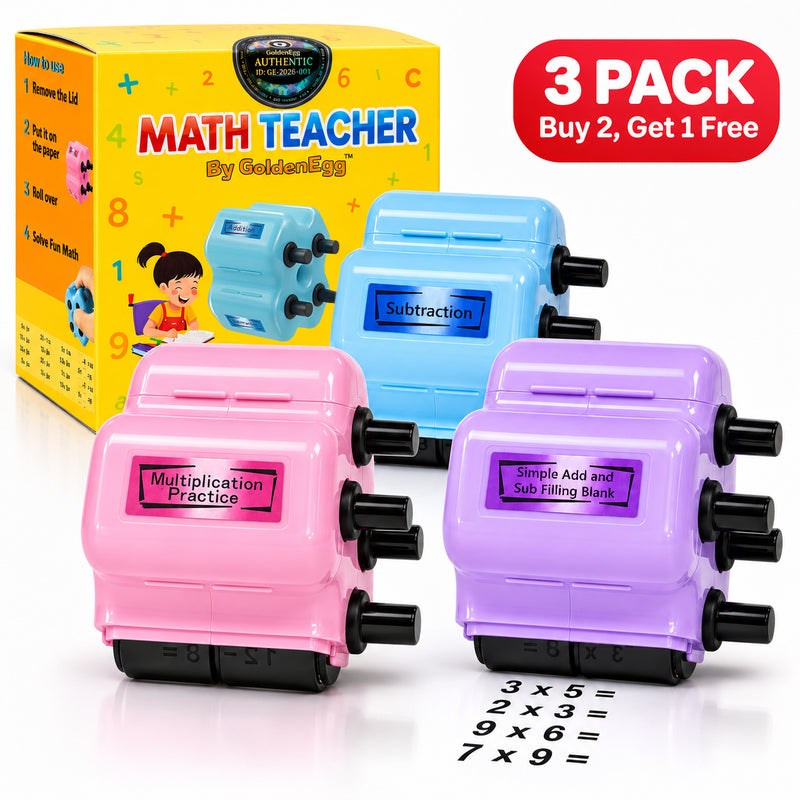
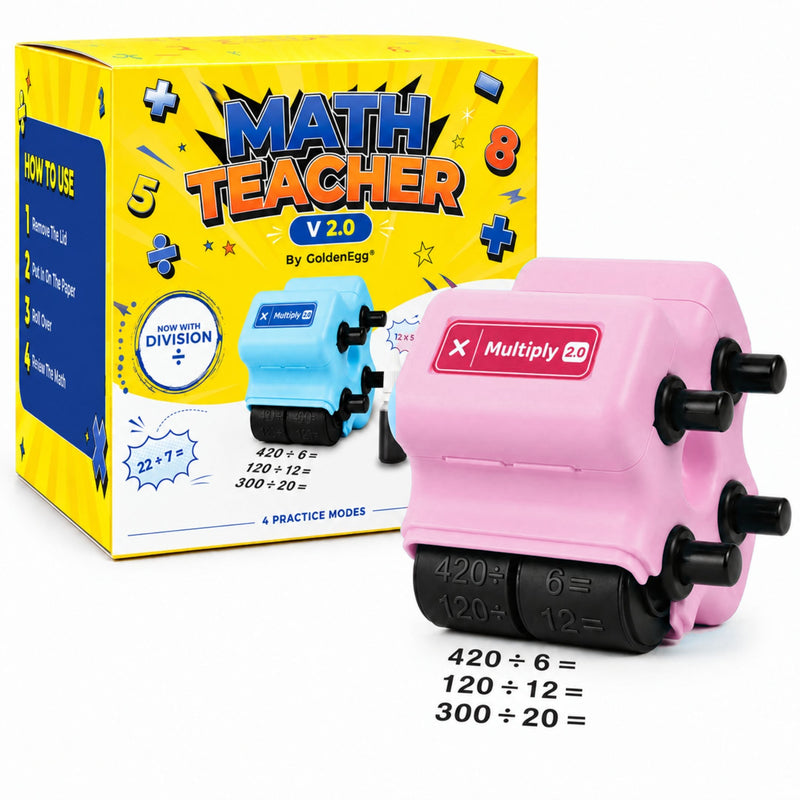
The Math Teacher 2.0 roller stamp (ages 7-10) is made for this stage. Roll it down any notebook page and it prints a fresh column of 2-digit addition or subtraction problems, with new numbers on every roll, so your child always has something new to solve. It also has bigger multiplication and long division for later.
Still building basic facts? The Original Math Teacher (ages 3-8) covers addition and subtraction facts, which need to be quick before regrouping feels easy.
Every stamp includes our free Math Help: snap a photo of the stamped page and every answer gets marked, with short video lessons that show how to fix mistakes.
Frequently Asked Questions
Final Thoughts
Regrouping is one idea used two ways: trade ten ones for a ten when adding, and trade a ten for ten ones when subtracting. Show it with real objects, say the steps out loud, and practice a little every day. Within a few weeks it becomes second nature.