How to Make Math Fun for Kids: 10 Hands-On Activities That Actually Work
March 18, 2026

How to Make Math Fun for Kids: 10 Hands-On Activities That Actually Work
Is your child dreading math homework? You're not alone. Studies show that nearly 1 in 3 kids experience math anxiety by the time they reach elementary school. The good news? Making math fun doesn't require expensive tutors or complicated lesson plans - just a little creativity and the right tools.
Why Kids Hate Math (And How to Fix It)
Most kids don't actually hate math - they hate boring worksheets. When math feels like a chore, kids shut down. But when math feels like a game, something clicks. The secret isn't making math easier - it's making it more engaging.
Here are 10 proven activities that teachers and parents swear by to turn math time from a battle into something kids actually look forward to.
1. Use a Math Roller Stamp for Instant Practice
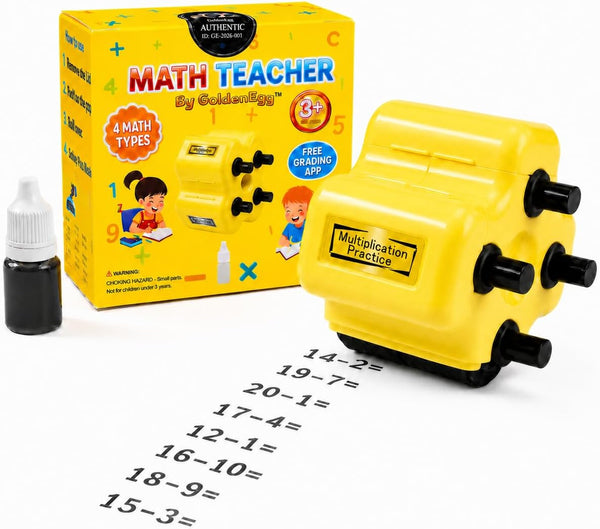
This is the tool that's been going viral with teachers and homeschool parents - and for good reason. A math roller stamp lets you create fresh math problems in seconds by simply rolling it across a piece of paper. Addition, subtraction, multiplication, and division - all from one small tool.
Why kids love it: It feels like a toy, not homework. Kids actually ask to "play" with the stamp. The novelty of rolling out their own worksheet makes them feel in control of their learning.
Why parents love it: No printer needed. No searching for PDFs online. No running out of worksheets. Just roll, practice, done.
Pro tip: Let your child stamp their own worksheet first - kids engage more when they feel ownership over the activity.
[Shop the GoldenEgg Math Teacher Roller Stamp →]
2. Turn Math Into a Board Game
Take any board game your child already loves and add a math twist. For example:
- Candy Land: Before moving, your child has to solve a math problem from the card.
- Uno: When you play a number card, both players race to add the two most recent cards together.
- Dice Games: Roll two dice and race to multiply them. First person to say the answer moves forward.
The key is that the math becomes the gateway to something they already want to do - playing.
3. Cook Together (Fractions Come Alive)
Baking is sneaky math education at its finest. When a recipe calls for 3/4 cup of flour, your child is doing fractions without even realizing it.
Try this: Double or halve a recipe together. Ask your child, "If we need 1/2 cup of sugar for one batch, how much do we need for two batches?" Suddenly, fractions aren't abstract - they're delicious.
4. Math Scavenger Hunt
Create a list of math challenges and hide them around the house or yard:
- "Find 3 things that are shaped like a rectangle"
- "Count the steps from the front door to the kitchen"
- "Find something that weighs more than your shoe"
This gets kids moving AND thinking - a powerful combination for learning retention.
5. Use Money (Real or Play)
Set up a pretend store at home. Price items at 25 cents, 50 cents, $1. Give your child play money and let them "shop." They'll practice addition, subtraction, and even making change without any worksheets involved.
For older kids: Give them a $5 budget and a real store flyer. Ask them to plan a snack purchase that stays under budget. Real-world math is the math that sticks.
6. Math With Music and Rhythm
Skip counting becomes 10x easier when it's set to a beat. Try clapping while counting by 2s, 5s, or 10s. There are great skip-counting songs on YouTube that kids latch onto quickly.
Why it works: Rhythm activates a different part of the brain than rote memorization. Kids who learn multiplication tables through songs often retain them longer.
7. Timed Math Challenges (Make It a Race)
Kids are naturally competitive. Use a timer and challenge them:
- "How many addition problems can you solve in 60 seconds?"
- "Can you beat yesterday's score?"
Pro tip: Use a math roller stamp to create a fresh set of problems every time so the challenge never feels repetitive. Rolling a new worksheet takes 5 seconds, and the randomized problems keep it fresh.
[Shop the GoldenEgg Math Teacher Roller Stamp →]
8. Build With Blocks (Geometry + Spatial Thinking)
LEGO, building blocks, or even cardboard boxes teach geometry, symmetry, and spatial reasoning. Ask questions while they build:
- "How many blocks tall is your tower?"
- "If you add 3 more blocks to each side, how many do you need total?"
- "Can you make this side symmetrical to the other side?"
9. Math Journaling
Give your child a notebook and ask them to write or draw about math every day. Prompts like:
- "Draw a picture that shows what 4 x 3 looks like"
- "Write about a time you used math today"
- "Invent your own math problem and solve it"
This builds metacognition - thinking about thinking - which research shows dramatically improves math performance.
10. Celebrate Progress, Not Perfection
The most important "activity" is your attitude. When a child gets a problem wrong, say "You're so close! Let's figure it out together" instead of "That's wrong." Kids who feel safe making mistakes learn faster than kids who are afraid of being wrong.
Track their progress visually - a chart on the fridge, stickers for completed practice sessions, or a simple "math streak" counter. Seeing their own improvement builds confidence, and confidence is the #1 predictor of math success.
The Bottom Line
Making math fun isn't about tricks or gimmicks - it's about changing the context. When math shows up inside games, cooking, shopping, and creative play, kids stop seeing it as a subject and start seeing it as a useful skill.
And for daily practice? Tools like the GoldenEgg Math Teacher Roller Stamp make it effortless to create fresh problems in seconds - no screens, no printers, just roll and go. It's the tool that teachers, parents, and homeschool families are calling a game-changer.
[Shop the Math Teacher Roller Stamp →]
Related Articles:
- Math Roller Stamp vs. Printable Worksheets: Which is Better?
- The Best Math Tools for Homeschool Families in 2026
- 5 Quick Math Practice Ideas for Kindergarten & First Grade
GoldenEgg makes math practice tools that are fast, fun, and reusable. Our Math Teacher Roller Stamp covers addition, subtraction, multiplication, and division for ages 4-12. [Shop now →]